Chemistry important short questions for class 9 are here. Chapter 2 (Atomic Structure), most important short questions. Prepare the best for the exam.
To read short questions for more chapters, go to the main menu here
Constructed Response Questions Chapter 2: Atomic Structure
Q1: Why does the energy of an electron increase as we move from the first shell to the second shell?
Answer: The second shell is farther from the nucleus than the first shell. As the distance from the positively charged nucleus increases, the electrostatic attraction holding the electron decreases, and the electron requires higher potential energy to remain in that outer orbit.
Q2: Why is it needed to lower the pressure of the gas inside the discharge tube?
Answer: Gas pressure is lowered so that gas molecules are spread far apart. This reduces collisions between gas particles and allows the electrical current to easily ionize the gas and let cathode rays travel smoothly without being blocked.
Q3: What is the classical concept of an electron? How has this concept changed with time?
Answer:
- Classical Concept: Originally, electrons were considered tiny, hard, sphere-like material particles moving in fixed circular paths.
- Modern Concept: With time, quantum mechanics proved that electrons behave as both particles and waves (dual nature), and they exist in 3D regions called “orbitals” rather than fixed orbits.
Q4: Why are the nuclei of radioactive elements unstable?
Answer: Radioactive nuclei are unstable because they have an unfavorable proton-to-neutron ratio or they are simply too large. This causes the nuclear force to be insufficient to hold the nucleus together, making it release excess energy as radiation to gain stability.
Q5: During discharge tube experiments, how did scientists conclude that the same type of electrons are present in all elements?
Answer: Scientists changed the cathode material and the gas inside the discharge tube several times. Every time, the properties of the cathode rays (electrons) remained exactly the same. This proved that electrons are a fundamental particle of all elements.
All short Questions + Additional
The video description is here to understand the full concept. (Link will be available soon)
Q.1 Why is it said that almost all the mass of an atom is concentrated in its nucleus? Ans. Almost all the mass of an atom is concentrated in its nucleus because the nucleus contains protons and neutrons, which have much greater mass than the electrons that orbit around the nucleus. Protons and neutrons are approximately 1836 times more massive than electrons.
Q.2 Why are elements different from one another?
Ans. Elements are identified by their atomic numbers. Elements are different from one another because each element has a unique atomic number and different properties. The number of electrons, protons, and neutrons in an atom determines its chemical behavior, which in turn distinguishes one element from another.
Q.3 How many neutrons are present in?
Ans. Each bismuth atom will have 83 protons and 83 electrons. The number of neutrons in bismuth will be calculated as follows: n = A – Z n = 210 – 83 = 127. So, each bismuth atom will have 127 neutrons.
Q.4 Why is tritium a radioactive element?
Ans. Tritium is a radioactive isotope of hydrogen because it has an unstable nucleus. Tritium undergoes radioactive decay, emitting low-energy beta radiation. Tritium has two neutrons, one proton, and one electron, making it heavier than the other two isotopes of hydrogen (Protium and Deuterium).
Q.5 How can an atom absorb and evolve energy?
Ans. An atom can evolve or absorb energy through a process called electron transition. When an electron in an atom jumps from a low-energy orbit to a high-energy orbit, it absorbs energy and when it jumps back from a high-energy orbit to a low-energy orbit, it releases energy. This energy is evolved or absorbed in the form of electromagnetic radiation, such as light or heat.
Q.6 Calculate the number of neutrons, protons and electrons in the following atoms:
i. 195Pt78, ii. 55Mn25, iii. 127I53.
Ans. i. 195Pt78Pt: Each Pt atom will have 78 protons & 78 electrons.
n = A – Z = 195 – 78 = 117.
So, each Pt atom will have 117 neutrons, 78 protons & 78 electrons.
ii. 55Mn25: Each Mn atom will have 25 protons & 25 electrons.
n = A – Z = 55 – 25 = 30.
So, each Mn atom will have 30 neutrons, 25 electrons & 25 protons.
iii. 127I53: Each I atom will have 53 protons & 53 electrons.
n = A – Z = 127 – 53 = 74. So, each I atom will have 74 neutrons, 53 protons & 53 electrons.
Q.7 Why isotopes of an element show same chemical properties while their physical properties are different?
Ans. i. Isotopes have same chemical properties because they have same electronic configuration and have same atomic number. ii. Isotopes have different physical properties because they have different mass number.
Q.8 Why does the radioactive isotope emit radiation? Give an example of a radioactive isotope which disintegrates to give a stable atom.
Ans. Several isotopes of the same elements exist whose nuclei are unstable. They are high in energy. They emit excess energy in the form of radiation. This process of emission is called radioactivity and the isotope which emits energy is called radioactive isotope.
Example: 210Bi83→206Ti81 +Energy.
Q.9 How would you compare the masses of the atoms of C, Mg and Cl?
Ans. The atomic mass of carbon is 12.01 amu, magnesium is 24.30 amu, and chlorine is 35.45 amu.
Mg atoms are 2.02 times heavier than C atoms (24.30/12.01=2.02).
Cl atom is 2.95 times heavier than C atom (35.45/12.01=2.95).
Cl atom is 1.45 times heavier than Mg atom (35.45/24.30=1.45). Carbon is the lightest atom among these three atoms.
Q.10 Calculate the relative atomic mass of lead (Pb). Isotopic abundances of isotopes 204Pb,206Pb,207Pb,208Pbare 2.0, 24.0, 22.0, and 52.0 respectively.
Ans. Relative atomic mass of Lead (Pb) = (2×204+24×206+22×207+52×208)/100=207.22.
Q.11 Have you ever thought why some elements are so different from one another?
Ans. Sulphur looks very different from gold, which, in turn, is very different from bromine. Similarly, iron is a heavy metal, while aluminium and zinc are light metals. Metals are mostly lustrous, while non-metals like sulphur and carbon appear dull. The difference in the properties of elements is due to the difference in the properties of their constituent atoms.
Q.12 Define Nuclear force.
Ans. The strong attractive force that binds protons and neutrons together. This force is stronger than electrostatic or magnetic forces. This force exists between neutrons and neutrons, protons and protons, and neutrons and protons.
Q.13 Why is the mass of an electron neglected for determining the mass of an atom? Ans. Protons and neutrons have roughly the same mass, around 1 amu. This mass contributes significantly to the total mass of the atom. Electrons have much less mass; the mass of an electron is about 1836 times less than the mass of a proton and neutron so their contribution to the total mass of an atom is usually negligible.
Q.14 How many times is cesium bigger than Helium?
Ans. The largest atom cesium, is approximately nine times bigger than the smallest atom, helium.
Q.15 What is the origin of Cathode & anode Rays?
Ans. Cathode rays are so named because they are emitted by the cathode in a discharge tube. A very high electrical potential of thousands of volts was applied in the discharge tube, which ionized the residual gas atoms present in the tube. The positive ions thus produced travelled towards the cathode as anode or canal rays. When they collided with the cathode, they knocked electrons out of its surface. This stream of electrons was called cathode rays.
Q.16 What is the structure of an atom?
Ans. Lord Rutherford, in 1911, concluded that an atom has two portions: A tiny central portion, which he called the nucleus, and a relatively large area surrounding this, which he called the extranuclear portion. The electrons are present in this extra-nuclear portion in the form of a cloud around the nucleus.
Q.17 Who first gave the idea of the atom? / Briefly describe the contribution of Democritus. Ans. The idea of atom was first proposed in Greece when the philosopher Democritus declared that all matter is made of tiny particles. He named this particle an atom, a particle that cannot be further subdivided.
Q.18 Who discovered an electron, a proton, and a neutron?
Ans.
i) Goldstein discovered positively charged particles called protons in 1886.
ii) Thomson found in an atom, the negatively charged particles known as electrons in 1897.
iii) Chadwick discovered the neutron in 1932.
Q.19 How does an electron differ from a neutron?
Ans.
Electron: Negatively charged, revolves around the nucleus, mass is 5.486×10⁻⁴ amu.
Neutron: Neutral particle, present in the nucleus, mass is 1.0087 amu.
Q.20 Differentiate between shell and subshell with examples of each.
Ans.
Shell: Each principal energy level in which an electron revolves around the nucleus is called a shell (e.g., K, L, M, N).
Sub Shell: Each shell further contains one or more sub-energy levels called subshells (e.g., s, p, d, f).
Q.21 What are sub-atomic particles?
Ans. Sub-atomic particles are the fundamental particles that make up atoms. The three main sub-atomic particles are: Electron, Proton, and Neutron.
Q.22 Compare the size of the nucleus with the size of the atom.
Ans. Although the nucleus is less than one hundred-thousandth (1/100,000) of the size of the atom, it contains more than 99.9% of the mass of the atom.
Q.23 How were cathode rays produced?
Ans. A discharge tube is provided with two metallic electrodes and a vacuum pump. When a very high voltage is applied to a gas at a very low pressure in a glass tube, the glass surface behind the positive electrode started to glow, due to the rays emitted from the cathode. These rays were named as cathode rays.
Q.24 Discuss the characteristics of cathode rays.
Ans.
i. Cathode rays bent towards the positively charged plate, showing that they carry negative charge.
ii. J.J. Thomson used findings to calculate the mass-to-charge ratio of cathode rays, which proved they are in fact negatively charged material particles.
iii. These particles were later named as electrons.
Q.25 How are ions and isotopes formed?
Ans. Changing the number of electrons of an element forms ions, while changing the number of neutrons of an element forms isotopes.
Q.26 Calculate the number of neutrons, protons and electrons in barium 137Ba56.
Ans. Each barium atom will have 56 protons and 56 electrons.
n = A – Z = 137 – 56 = 81. So each 137Ba56 atom will have 81 neutrons, 56 protons, and 56 electrons.
Q.27 Define Proton number/ Atomic number.
Ans. Proton number refers to the number of protons in the nucleus of an atom. It is also known as the atomic number and is indicated by the symbol “Z”.
Q.28 Define Nucleon number/ atomic mass.
Ans. The sum of the total number of protons and neutrons in an atom is known as its mass number or nucleon number. It is represented by A.
Q.29 Give an example of a synthetic element.
Ans. Copernicium (Cn) is a synthetic element, and it was discovered in 1996. This metal turns into a gas at room temperature.
Q.30 Define Isotopes.
Ans. Isotopes are atoms of an element that have the same atomic number but different mass numbers. This is because atoms of an element can differ in the number of neutrons.
Q.31 What are the isotopes of hydrogen?
Ans. Hydrogen has three isotopes: Hydrogen-1 (Protium) has no neutrons; Hydrogen-2 (Deuterium) has one neutron; and Hydrogen-3 (Tritium) has two neutrons. Their symbols are 1H1, 2H1, and 3H1 respectively.
Q.32 What do you know about isotopes of carbon?
Ans. Carbon has three isotopes: Carbon-12, Carbon-13 and Carbon-14. Carbon-12 has six neutrons and six protons (12C6). Carbon-13 has seven neutrons and six protons (13C6). Carbon-14 has eight neutrons and six protons (14C6).
Q.33 Define radioactivity and radioactive isotopes.
Ans. Several isotopes of the same elements exist whose nuclei are unstable. They emit excess energy in the form of radiation. This process of emission is called radioactivity and the isotope which emits energy is called radioactive isotope.
Q.34 Define relative isotopic masses.
Ans. An element usually consists of a few different isotopes with different mass numbers. These mass numbers are called relative isotopic masses.
Q.35 Define atomic mass unit. Why is it needed?
Ans. The unit for relative atomic mass is called the atomic mass unit (amu). One atomic mass unit is 1/12th the mass of one atom of the carbon-12 isotope. It is needed because the mass of an atom is too small to be determined practically.
Q.36 Define relative isotopic mass. How can relative atomic mass be determined?
Ans. Relative atomic mass of an element can be calculated from the relative isotopic masses (m) and isotopic abundances (p) by the formula:
Relative atomic mass = m1p1+m2p2+m3p3/100.
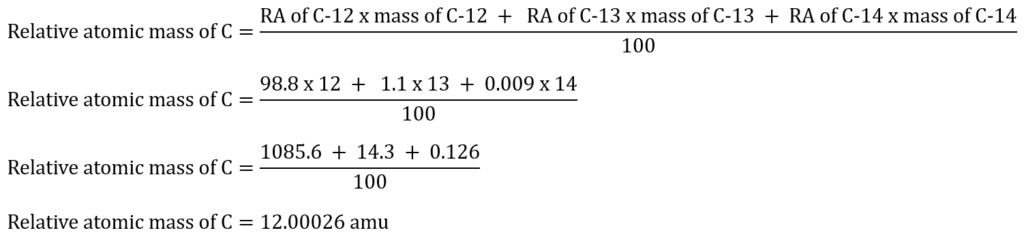
Q.37 Calculate the relative atomic mass of carbon.
Ans. Relative atomic mass is the weighted average of all the naturally occurring isotopes of an element. Taking into consideration their natural abundance. Use the general formula.
Q.38 Calculate the relative atomic mass of Krypton (Kr). Isotopic abundances of isotopes 80, 82, 83, 84, 85 are 2.0, 12.0, 12.0, 57.0 and 57.0
Ans. Relative atomic mass of krypton =(80×2.0+82×12.0+83×12.0+84×17.0+85×57.0)/100=83.7amu
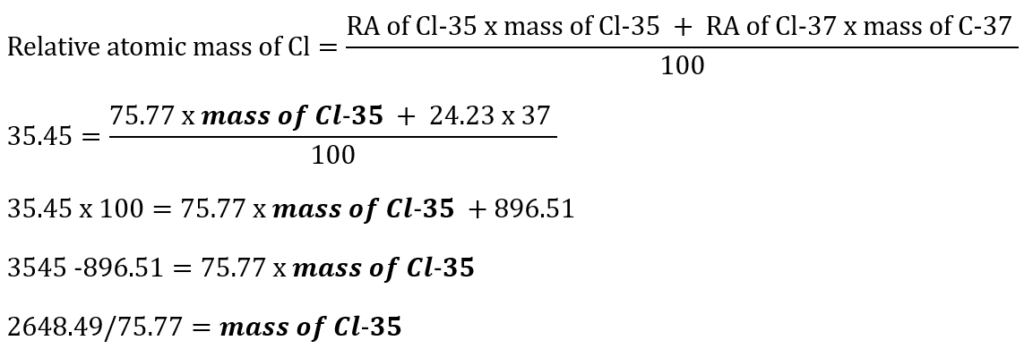
Q.39 Calculate the relative atomic mass of the light isotope of chlorine when its relative atomic mass is taken as 35.45.
Ans. Relative isotopic abundance of Cl-37 = 24.23%.
Relative isotopic abundance of light isotope of chlorine = 75.77%.
The relative atomic mass of the light isotope of chlorine is 35.45.
Q.40 What is meant by carbon dating or radio-carbon dating?
Ans. Radiocarbon dating is a method for finding out the age of an historical object containing organic material with the help of the radioactive isotope of carbon C-14. The method involves measuring the proportion of C-14 in a sample from a dead plant or animal. The older the sample is, the less C-14 can be detected.
Q.41 What is gallium that makes it unique from other metals?
Ans. Gallium’s melting point is below body temperature, so it is liquid at room temperature. It has water like viscosity. It does not evaporate.
Q.42 How are the particles arranged in a tiny place? What is the structure of an atom?
Ans. Rutherford concluded that an atom has two portions: a tiny central portion called the nucleus and a relatively large area surrounding this called the extra-nuclear portion. Protons and neutrons are found in the nucleus, held together by a strong nuclear force.
Q.43 Write the contribution of Neil Bohr.
Ans. In 1913, Neil Bohr proposed a model for the hydrogen atom called Bohr’s atomic model. According to this, the electron can revolve around the nucleus of the atom in specific paths called orbits or shells with fixed energy.
Q.44 How can atoms be seen?
Ans. The size of an atom is so small that it is not possible to see it with the naked eye. However, a transmission electron microscope (TEM) can be used to see atoms.
Q.45 How to find out the no. of electrons in a shell?
Ans. To find out the number of electrons which can be accommodated in these extra-nuclear shells, the scientists have devised a formula called the (2n2) formula where n can have values 1, 2, 3… and they represent the number of shells (K, L, M, N…).
Q.46 How many times cesium is bigger than helium?
Ans. The largest atom cesium is approximately nine times bigger than the smallest atom, helium.
Q.47 How many atoms does our body replace every year?
Ans. Every year, our body replaces about 98% of its atoms.