These are the free notes for Class 9 Chapter 11 Chemistry. Exercise short questions, CRQs, and internal short questions are included. It is about Organic chemistery specially Hydrocarbons, written by Sir Umair Khan.
All notes for class 9 Chemistry are here, and All Video lectures are here. Watch and subscribe, please
1- MCQ Questions.
- Which other atom is almost always present along with the carbon atom in all organic compounds?
(a) Oxygen (b) Nitrogen (c) Hydrogen (d) Halogen - Which other metal can be used to reduce alkyl halides?
(a) Al (b) Mg (c) Ni (d) Co - If naphtha undergoes a combustion reaction, what products do you expect it to form?
(a) Alkanes (b) Alkenes (c) CO2 and H2O (d) Both alkanes and alkenes - Why does a mixture of zinc and hydrochloric acid act as a reducing agent?
(a) Because zinc acts as a reducing agent.
(b) Because atomic hydrogen is produced with Zn / HCl, which acts as a reducing agent.
(c) Because molecular hydrogen is produced with Zn / HCl, which acts as a reducing agent.
(d) Because chloride ions are produced with Zn / HCl, which acts as a reducing agent. - Which alkane will evolve the most amount of heat when it is burnt with oxygen?
(a) Ethane (b) Propane (c) n-Butane (d) iso-Butane - Which reaction is not given by alkanes?
(a) Substitution (b) Combustion (c) Addition (d) Cracking - Which hydrocarbon is responsible for explosions in coal mines?
(a) Butane (b) Pentane (c) Methane (d) Ethene - Which product will be formed when ethyl bromide (CH3 CH2 Br) is treated with Zn/HCl?
(a) CH4 (b) CH3-CH3 (c) CH3-CH2-CH2-CH3 (d) CH3-CH2-CH3 - Which of the following is not a process of halogenation of alkanes?
(a) Cracking (b) Chlorination (c) Bromination (d) Iodination - How many moles of oxygen will be required to completely burn propane?
(a) 4 moles (b) 5 moles (c) 3 moles (d) 6 moles
2. Questions for Short Answers
i. Differentiate between an organic and an inorganic compound.
Organic Compounds:
The compounds contain carbon and hydrogen as their main elements (hydrocarbons) and their derivatives, usually held together by covalent bonds called organic compounds e.g., methane, glucose.
Inorganic Compounds:
The compounds obtained from non-living minerals that generally do not contain carbon-hydrogen bonds, usually held together by ionic bonds e.g., sodium chloride, water.
ii. Why are organic compounds found in large numbers?
Organic compounds exist in millions due to:
- Catenation: The unique ability of carbon atoms to form long chains or rings by bonding with other carbon atoms.
- Isomerism: Compounds having the same molecular formula but different structural arrangements.
- Multiple Bonding: Carbon’s ability to form single, double, and triple covalent bonds.
iii. Name the products which are obtained when natural gas is oxidized under controlled conditions.
When natural gas (mainly methane) undergoes controlled catalytic oxidation, it produces:
- Methyl alcohol (Methanol)
- Formaldehyde (Methanal)
- Formic acid (Methanoic acid)
iv. How naphtha fraction is decomposed to give lower hydrocarbons?
Naphtha is decomposed into lower hydrocarbons through thermal cracking (or steam cracking). In this process, heavier naphtha vapors are heated to high temperatures around 500°C, in the presence of zeolite, breaking large hydrocarbon molecules into smaller alkenes and alkanes containing 5 to 10 carbon atoms.
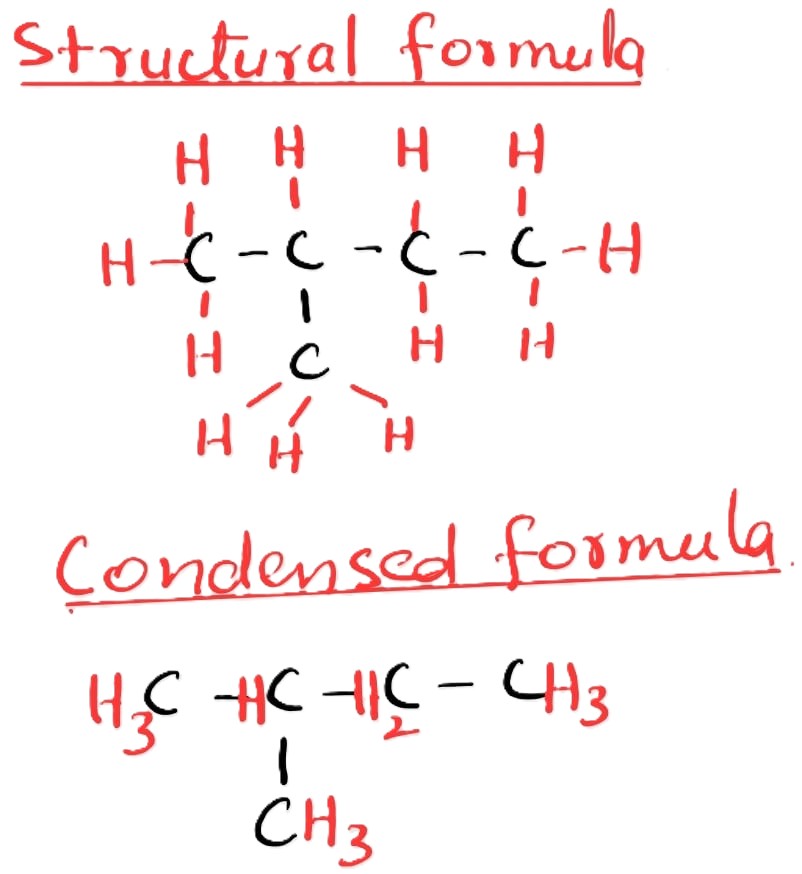
v. Write down the molecular formula, structural formula and the condensed structural formula for iso-butane.
- Molecular Formula: C5H12
- Condensed Structural Formula:
- Structural Formula
vi. How are organic compounds useful for us?
Organic compounds are essential to daily life:
Fuels: Natural gas, gasoline, and LPG provide energy for cooking, heating, and transport.
Medicines: Antibiotics, aspirin, and life-saving drugs are organic compounds.
Materials: Plastics, synthetic fibers (nylon, polyester), dyes, and soaps are made from organic compounds.
vii. Write down the names of five such organic compounds which exist naturally?
Methane (found in natural gas)
Glucose (found in fruits and blood)
Sucrose (cane sugar)
Starch (found in wheat and potatoes)
Cellulose (found in plant cell walls and cotton)
viii. Give IUPAC name to the following compound:
IUPAC Name: 2-methylbutane
ix. How do the melting and boiling points of alkanes change when we move from lower members to higher members?
As we move from lower to higher alkanes, their melting and boiling points increase. This happens because as molecular mass and chain length increase, and strengthen the intermolecular forces between molecules.
3-Constructed Response Questions
i. Why do alkanes show little reactivity towards the other reagents?
Alkanes show low reactivity (and are called paraffins) because:
Non-polar Bonds: The electronegativity difference between carbon and hydrogen is negligible, making C-H and C-C bonds non-polar.
Strong Bonds: All carbon atoms are joined by strong single bonds, which require high energy to break under normal conditions.
ii. Why does a mixture of natural gas and air explode?
Natural gas (primarily methane) reacts rapidly with oxygen in the air in an extremely exothermic reaction. When exposed to a spark or flame, the rapid combustion releases a massive volume of expanding hot gases (CO2 and H2O) and thermal energy instantaneously, causing a violent explosion.
iii. How do you compare the melting and boiling points of inorganic and organic compounds?
Inorganic Compounds: Have high melting and boiling points because they are mostly ionic compounds held together by strong electrostatic forces of attraction.
Organic Compounds: Have low melting and boiling points because they consist of covalent molecules held together by relatively weak intermolecular forces.
iv. Reactions of alkanes with chlorine take place in the presence of sunlight. What is the role of sunlight in the reaction?
Sunlight (specifically ultraviolet light) acts as an energy source that breaks chlorine molecule, splitting it into highly reactive chlorine free radicals. These free radicals initiate the substitution reaction with alkane molecules.
v. How do you compare the boiling point of n-butane with that of iso-butane?
n-butane has a higher boiling point (-0.5°C) because it is a straight-chain molecule with a larger surface area, leading to stronger intermolecular forces.
iso-butane has a lower boiling point (-11.7°C) because its branched spherical shape reduces the contact surface area between molecules, weakening the intermolecular forces.
vi. Why are organic compounds not generally soluble in water?
According to the principle “like dissolves like”:
Water is a highly polar solvent, whereas most organic compounds are non-polar or weakly polar. Because organic molecules cannot form favorable attractive interactions or hydrogen bonds with polar water molecules, they do not dissolve in water (but dissolve readily in non-polar organic solvents like benzene or ether).
Internal Short Questions
(i) How do the melting and boiling points of alkanes change when we move from lower members to higher members? (ii) Why is the combustion of hydrocarbons an exothermic reaction? (iii) Give the IUPAC name of CH ₃-CH ₂-CH ₃ . (iv) What is the IUPAC name of isobutane? (v) Write the reaction for the halogenation of methane. (vi) Name the compound with the molecular formula C ₂ H ₆ . (vii) Name the products which are obtained when natural gas is oxidized under controlled conditions. (viii) How naphtha fraction is decomposed to give lower hydrocarbons? (ix) What does the root name in IUPAC nomenclature indicate? (x) Why is methane leakage dangerous in homes? (xi) Name the products formed when methane reacts with excess chlorine. (xii) Why are organic compounds so numerous? (xiii) What happens if methane is burned in a limited supply of oxygen? (xiv) Why is cracking of hydrocarbons important? (xv) What are photochemical substitution reactions? (xvi) When a natural gas valve is kept open in the kitchen, the gas spreads through the whole kitchen. This may cause an explosion. What is the reason for this explosion, and how can you avoid it? (xvii) Why are organic compounds not generally soluble in water? (xviii) Why is cracking necessary in the petroleum industry? (xix) Why do alkanes show little reactivity towards other reagents? (xx) What is meant by the term “parent hydrocarbon”? (xxi) Why do alkanes show little chemical reactivity? (xxii) What happens to the boiling point of alkanes as the carbon chain increases? (xxiii) Differentiate between an organic and an inorganic compound. (xxiv) What is the product of complete combustion of methane? (xxv) How does the presence of a catalyst affect cracking? (xxvi) What are alkanes? (xxvii) Why are alkanes called saturated hydrocarbons? (xxviii) Why do alkanes undergo substitution reactions instead of addition reactions? (xxix) Why are alkanes considered chemically unreactive? (xxx) Name the first four alkanes in the homologous series. (xxxi) What is meant by structural formula? (xxxii) Why are carbonates, cyanides, and carbides classified as inorganic compounds? (xxxiii) What catalyst is used in cracking? (xxxiv) Why are the bonds in alkanes considered non-polar? (xxxv) How many bonds does each carbon atom form in an alkane molecule? (xxxvi) How are organic compounds useful for us? (xxxvii) Why are organic compounds found in large numbers? (xxxviii) How can alkanes be prepared from alkyl halides? (xxxix) What are the three main parts of an organic compound’s IUPAC name? (xl) Why is the longest chain rule important in IUPAC nomenclature? (xli) Write down the molecular formula, structural formula and the condensed structural formula for iso-butane. (xlii) Why are alkanes called paraffins? (xliv) What is meant by substitution reaction? (xlv) What is the general formula of alkanes? (xlvi) What is cracking? (xlvii) Write the structural formula of methane. (xlviii) Why does carbon form covalent bonds instead of ionic bonds? (xlix) What is a prefix in IUPAC nomenclature? (l) Neem is a common tree grown throughout our country. Comment on the medicinal benefits of this tree. (51) Define hydrocarbons. (52) What is catenation? (53) How does the small size of carbon atoms contribute to the stability of organic compounds? (54) Why does a mixture of natural gas and air explode? (55) How is the position of a branch indicated in a hydrocarbon’s name? (56) What is organic chemistry? (57) How are alkanes different from alkenes and alkynes? (58) Write down the names of five such organic compounds which exist naturally? (59) Give two examples of hydrocarbons used as fuels. (60) Write the reaction for the hydrogenation of ethene. (61) How do you compare the melting and boiling points of inorganic and organic compounds? (62) Write the reaction of chloromethane with Zn/HCl. (63) Reactions of alkanes with chlorine take place in the presence of sunlight. What is the role of sunlight in the reaction? (64) Name a few popular medicines which are, in fact, organic compounds. (65) What is the role of nickel in hydrogenation? (66) How do you compare the boiling point of n-butane with that of isobutane? (67) Name some important biomolecules that contain carbon. (68) What is the IUPAC name of CH ₄ ?