These are the free notes for Class 10 Chapter 18 Chemistry. Exercise short questions, CRQs, and internal short questions are included. It is about salts and related material, written by Sir Umair Khan.
All notes for class 9 Chemistry are here, and All Video lectures are here. Watch and subscribe, please
Short Answer Questions
18.1 Which factors are responsible for the strength of electrostatic forces between ions?
The strength of electrostatic forces of attraction between oppositely charged ions in a salt lattice depends on two primary factors:
- Magnitude of Ionic Charges: Ions carrying higher charges exert stronger electrostatic attractions on each other.
- Distance Between Ions / Size of Ions: Smaller ionic radii decrease the inter-ionic distance, leading to significantly stronger electrostatic attraction.
18.2 Is lead (II) chloride soluble in water? Give comments.
- Solubility Status: No, lead (II) chloride (PbCl₂) is insoluble in cold water.
- Comments: Under general solubility rules, most metallic chlorides are soluble in water; silver chloride (AgCl) and lead (II) chloride (PbCl₂) are notable exceptions that do not dissolve.
18.3 Which lead salts are insoluble in water?
The primary lead (II) salts that are insoluble in water include:
- 1.: Lead (II) chloride (PbCl₂)
- 2.: Lead (II) sulfate (PbSO₄)
- 3.: Lead (II) carbonate (PbCO₃)
18.4 Name two insoluble carbonates.
All metallic carbonates are insoluble in water, except sodium, potassium, and ammonium carbonates. Two examples of insoluble carbonates are:
- 1.: Calcium carbonate (CaCO₃)
- 2.: Magnesium carbonate (MgCO₃) / Copper carbonate (CuCO₃)
18.5 What is a crystal lattice?
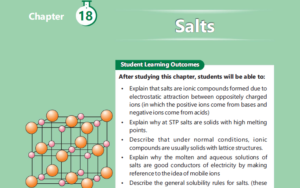
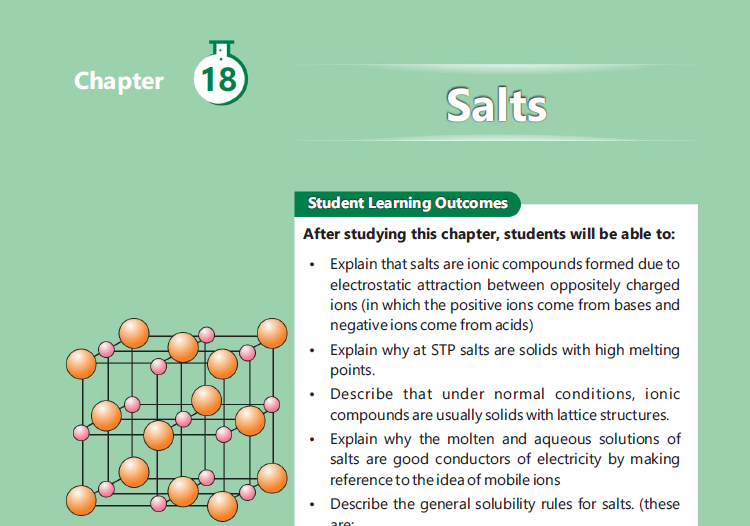
A crystal lattice is a regular, repeating three-dimensional network structure formed by oppositely charged ions arranging themselves in an ordered pattern.
Constructed Response Questions
18.1 Why are melting points of ionic salts generally very high?
- Structural Reason: In an ionic crystal lattice, oppositely charged cations and anions are bound together by extremely strong electrostatic forces of attraction.
- Thermodynamic Process: Melting requires supplying a large amount of thermal energy to overcome and break down these powerful inter-ionic attractions so that ions can move freely.
- Conclusion: Because significant energy is required to disrupt this tight network, ionic salts possess characteristically high melting points.
18.2 Why do ionic salts exist in solid state?
- Inter-ionic Forces: Under ordinary conditions of temperature and pressure, electrostatic attractions holding positive and negative ions together are exceedingly strong.
- Lattice Rigidity: These forces lock the ions tightly into fixed positions in a 3D repeating crystal lattice, preventing translational movement.
- Conclusion: Because the constituent particles are tightly bound in fixed positions, ionic compounds naturally exist as crystalline solids.
18.3 How will you prepare calcium sulphate in the laboratory?
- Method: Calcium sulphate (CaSO₄) is an insoluble salt. It is prepared by the precipitation method (double displacement reaction) by mixing aqueous solutions of two soluble salts.
| Chemical Equation: CaCl2(aq) + Na2SO4(aq) → CaSO4(s)↓ + 2NaCl(aq) |
- Procedure Step 1: Dissolve a soluble calcium salt (e.g., CaCl₂) and a soluble sulphate salt (e.g., Na₂SO₄) separately in distilled water.
- Procedure Step 2: Mix the two solutions together in a beaker with constant stirring. A white precipitate of CaSO₄ forms immediately.
- Procedure Step 3: Filter the mixture to collect the precipitate on filter paper.
- Procedure Step 4: Wash the residue with cold distilled water to remove soluble sodium chloride (NaCl).
- Procedure Step 5: Dry the calcium sulphate precipitate between folds of filter paper.
18.4 Compare the melting points of NaCl and MgCl₂.
- Governing Rule: The melting points of ionic salts depend on the magnitude of ionic charges and the ionic radii. Higher charges and smaller radii create stronger electrostatic attractions.
- Ionic Properties: In NaCl, the cation is Na⁺ (+1 charge). In MgCl₂, the cation is Mg²⁺ (+2 charge) and has a smaller ionic radius than Na⁺.
- Conclusion: Because Mg²⁺ carries a higher charge (+2 vs +1) and has a smaller radius, inter-ionic attraction in MgCl₂ is stronger than in NaCl. Consequently, MgCl₂ has a higher melting point than NaCl.
18.5 How would you prepare pure crystals of copper sulfate in the laboratory?
- Method: Copper sulphate (CuSO₄) is a soluble salt. It is prepared by reacting dilute sulphuric acid with an excess of an insoluble base (Copper(II) Oxide, CuO).
| Chemical Equation: CuO(s) + H2SO4(aq) → CuSO4(aq) + H2O(l) |
- Step 1 (Heating Acid): Measure ~25 cm³ of dilute H₂SO₄ into a beaker and warm gently.
- Step 2 (Reaction): Add CuO powder in small amounts with constant stirring until no more dissolves and black powder remains at the bottom.
- Step 3 (Filtration): Filter the mixture to remove excess undissolved CuO and collect the clear blue filtrate of CuSO₄.
- Step 4 (Evaporation): Heat the filtrate gently in an evaporating dish until concentrated to its crystallization point.
- Step 5 (Crystallization): Allow the hot saturated solution to cool slowly at room temperature to form pure blue crystals (CuSO₄·5H₂O).
- Step 6 (Drying): Filter off the crystals, rinse with cold distilled water, and dry between folds of filter paper.