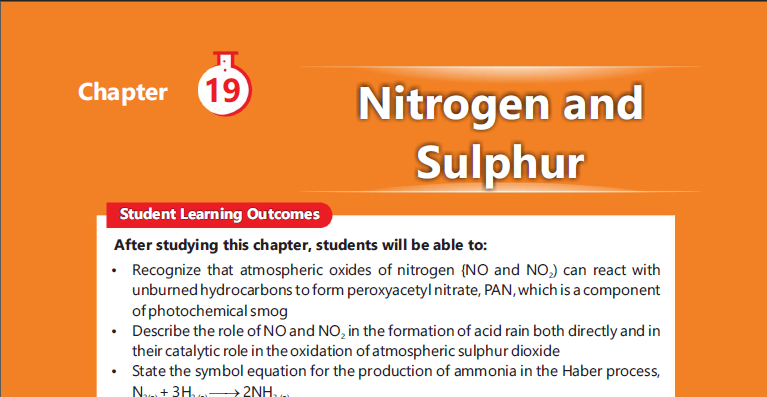
These are the free notes for Class 10 Chapter 19 Chemistry. Exercise short questions, CRQs, and internal short questions are included. It is about nitrogen and sulphur and related material, written by Sir Umair Khan.
All notes for class 9 Chemistry are here, and All Video lectures are here. Watch and subscribe, please
MCQs from Exercise.
1. The reason for maintaining higher temperature for the production of ammonia is:
(a) activation energy of the reaction is very high.
(b) activation energy of the reaction is very low.
(c) nitrogen and hydrogen are both gases.
(d) at low temperature nitrogen and hydrogen change into liquids.
2. The contact process used for the industrial production of H2SO4 is sensitive to the impurities present in SO2 and O2 because the impurities:
(a) affect the capability of the catalyst
(b) affect the purity of H2SO4
(c) do not let SO2 to react with oxygen
(d) decrease the rate of reaction appreciably
3. Which of the following oxides is neutral in character?
(a) Al2O3
(b) SO2
(c) CO2
(d) NO
4. Sodium is considered more reactive than magnesium because:
(a) It is more electropositive than magnesium
(b) It reacts with water slowly.
(c) It is present in second group
(d) It is the less metallic
5. Secondary pollutants present in the atmosphere are:
(a) Oxides of nitrogen
(b) Oxides of Sulphur
(c) Ozone and PAN
(d) Oxides of Carbon
6. SO3 is absorbed in H2SO4 rather than H2O during the production of sulphuric acid because:
(a) SO3 does not react with H2O
(b) reaction of SO3 with H2O is highly exothermic producing mist of H2SO4 which is difficult to condense.
(c) It gives better yield of H2SO4
(d) reaction of SO3 with H2O can cause explosion.
7. Oxides formed when oxygen reacts with metals:
(a) Acidic
(b) Basic
(c) Both basic and amphoteric
(d) Neutral
8. Major components of acid rain are:
(a) H2SO4 and HNO3
(b) H2SO3 and HNO2
(c) H2SO4 and HCl
(d) Acetic acid and HNO3
Chapter 19 Exercise — Short Answer Questions
19.1 How is nitrogen obtained from air?
- Industrial Method: Nitrogen gas is obtained on an industrial scale by the fractional distillation of liquid air.
- Step 1 (Purification): Atmospheric air is passed through filters and chemical scrubbers to remove dust particles, carbon dioxide, and water vapor.
- Step 2 (Liquefaction): Purified air is compressed to approximately 200 atm pressure, cooled, and expanded repeatedly through fine jets until it liquefies at -200°C.
- Step 3 (Fractional Distillation): Liquid air is warmed slowly in a fractionating column. Nitrogen boils off first at its lower boiling point of -196°C, while liquid oxygen remains behind at the bottom (-183°C).
19.2 How is hydrogen produced from methane?
- Method: Hydrogen is produced from natural gas (methane, CH₄) via Steam Methane Reforming (SMR) in two stages:
- Stage 1 (Steam Reforming): Methane reacts with steam at 700–1000°C over a nickel catalyst to form carbon monoxide and hydrogen:
| CH4 (g) + H2O (g) → CO (g) + 3 H2 (g) (700–1000°C, Ni Catalyst) |
- Stage 2 (Water-Gas Shift): Carbon monoxide is further reacted with steam over an iron/copper catalyst to yield additional hydrogen gas:
| CO (g) + H2O (g) → CO2 (g) + H2 (g) (Fe/Cu Catalyst) |
19.3 Which conditions are used to oxidize SO2 to SO3?
The oxidation of sulphur dioxide (SO₂) to sulphur trioxide (SO₃) in the Contact Process requires the following optimum reaction conditions:
- Catalyst: Vanadium(V) oxide (V₂O₅).
- Temperature: 450°C (an optimum balance between rate of reaction and equilibrium yield for this exothermic process).
- Pressure: 1–2 atm (slight positive pressure is sufficient to achieve >98% conversion).
| 2 SO2 (g) + O2 (g) ⇌ 2 SO3 (g) (V2O5 Catalyst, 450°C, 1–2 atm, ΔH = -196 kJ/mol) |
19.4 Why CO2 is called an acidic oxide while CO is called a neutral oxide?
- Carbon Dioxide (CO2) – Acidic Oxide: When dissolved in water, CO₂ reacts to form carbonic acid (H₂CO₃), turning blue litmus paper red. It also reacts readily with alkalis to form carbonate salts:
| CO2 (g) + H2O (l) ⇌ H2CO3 (aq) CO2 (g) + 2 NaOH (aq) → Na2CO3 (aq) + H2O (l) |
- Carbon Monoxide (CO) – Neutral Oxide: CO does not react with water to form an acid or base. Its solution has no effect on red or blue litmus paper and it reacts with neither acids nor alkalis under standard conditions.
19.5 How do magnesium and calcium differ with each other towards their reactions with water?
Calcium is lower in Group 2 than magnesium, making it significantly more electropositive and reactive towards water:
| Reaction Type | Calcium (Ca) | Magnesium (Mg) |
| Cold Water | Reacts readily with cold water to form Ca(OH)₂ solution and H₂ gas bubbles: Ca (s) + 2 H₂O (l) → Ca(OH)₂ (aq) + H₂ (g) | Does not react with cold water (reacts extremely slowly over days). |
| Steam (100°C) | Reaction with steam is dangerously violent. | Reacts vigorously with steam to form solid white MgO and H₂ gas: Mg (s) + H₂O (g) → MgO (s) + H₂ (g) |
19.6 How are the reactivities of metals determined?
The relative reactivity of metals is determined by measuring their tendency to lose valence electrons and form cations across standardized chemical reactions:
- 1. Reaction with Water/Steam: Metals at top (K, Na, Ca) react with cold water; middle metals (Mg, Al, Zn, Fe) react with steam; bottom metals (Cu, Ag) do not react.
- 2. Displacement of Hydrogen from Acids: More reactive metals displace H₂ gas vigorously from dilute HCl/H₂SO₄. Metals below hydrogen do not react.
- 3. Metal Displacement Reactions: A more reactive metal displaces a less reactive metal from its aqueous salt solution (e.g., Zn + CuSO₄ → ZnSO₄ + Cu).
- 4. Reaction with Oxygen: Vigor and speed of oxide layer formation upon heating in air.
19.7 Which secondary pollutants are produced by oxides of nitrogen?
Oxides of nitrogen (NOx, i.e., NO and NO₂) in the presence of sunlight and atmospheric air produce the following secondary pollutants:
- 1. Ground-level Ozone (O3): Formed when photodecomposed oxygen atoms from NO₂ combine with atmospheric molecular oxygen (O₂).
- 2. Peroxyacetyl Nitrate (PAN): Produced by reactions between NOx and volatile organic compounds (VOCs).
- 3. Photochemical Smog: A toxic brown atmospheric haze consisting of ozone, PAN, aldehydes, and NO₂.
- 4. Nitric Acid (HNO3) / Acid Rain: Formed when NO₂ reacts with atmospheric water vapor:
- 4 NO₂ + 2 H₂O + O₂ → 4 HNO₃.
Chapter 19 — Constructed Response Questions
19.1 Why ammonia is regarded as an important chemical?
- Agricultural Importance: Over 80% of globally produced ammonia is used to manufacture essential nitrogenous fertilizers such as urea, ammonium nitrate, and ammonium sulphate, supporting global food production.
- Nitric Acid Production: Serves as the primary feedstock in the Ostwald process to produce nitric acid (HNO₃), vital for manufacturing industrial chemicals and explosives.
- Synthetic Polymers & Fibers: Essential building block for producing plastics, nylon, synthetic resins, and pharmaceuticals.
- Industrial Refrigerant: Widely utilized as an eco-friendly commercial refrigerant due to its high latent heat of vaporization.
19.2 How SO2 present in the atmosphere is converted to SO3?
Atmospheric sulphur dioxide (SO₂) emitted from volcanic and fossil fuel combustion sources is converted into sulphur trioxide (SO₃) through three main pathways:
- 1. Direct Oxidation by Oxygen: A slow atmospheric reaction under sunlight: 2 SO₂ (g) + O₂ (g) → 2 SO₃ (g).
- 2. Oxidation by Ozone (O3): Rapid atmospheric reaction: SO₂ (g) + O₃ (g) → SO₃ (g) + O₂ (g).
- 3. Catalytic Oxidation by NO2: Atmospheric NO₂ acts as a catalyst/carrier: SO₂ + NO₂ → SO₃ + NO, followed by NO oxidation back to NO₂. The generated SO₃ reacts with cloud water droplets to form sulphuric acid rain.
19.3 The burning of fossil fuels in a car engine is responsible for the production of oxides of nitrogen. Explain.
- High Temperature Conditions: In an internal combustion engine, fuel combustion generates extreme temperatures (1500–2000°C) and high pressures.
- Reaction of Air Nitrogen & Oxygen: Although nitrogen gas (N₂) is chemically inert at room temperature due to its strong triple covalent bond (N≡N), engine ignition spark provides the high activation energy needed to break this bond.
| N2 (g) + O2 (g) → 2 NO (g) (1500–2000°C in engine) 2 NO (g) + O2 (g) → 2 NO2 (g) (In tailpipe exhaust) |
Nitric oxide (NO) formed inside the engine oxidizes in exhaust air to nitrogen dioxide (NO₂), releasing harmful NOx into the atmosphere.
19.4 The metals present at the top of the reactivity series are regarded as more reactive than those present at the bottom. Comment on this statement.
- Validity: This statement is completely correct and scientifically grounded in atomic structure and electropositivity.
- Top Metals (e.g., K, Na, Ca): Possess large atomic radii and low ionization energies. They readily lose valence electrons to form positive cations, acting as powerful reducing agents. They react vigorously with cold water, dilute acids, and air.
- Bottom Metals (e.g., Cu, Ag, Au): Have high ionization energies and hold valence electrons tightly. They resist oxidation, do not react with cold water or dilute acids, and occur uncombined in nature.
19.5 How do fossil fuels produce SO2?
- Sulphur Impurities in Fuel: Fossil fuels (coal, crude oil, natural gas) formed from ancient organic matter contain organic sulphur compounds and inorganic sulfide minerals (e.g., iron pyrites, FeS₂).
- High-Temperature Combustion: When fossil fuels are burned in power stations and vehicle engines, sulphur impurities oxidize rapidly with atmospheric oxygen to yield sulphur dioxide gas:
| S (in fuel) + O2 (g) → SO2 (g) 4 FeS2 (s) + 11 O2 (g) → 2 Fe2O3 (s) + 8 SO2 (g) |
The evolved SO₂ gas escapes through industrial stacks into the air, acting as a primary air pollutant responsible for respiratory distress and acid rain.
Additional Short Questions (Internal)
Q1: Write down the uses of ammonia.
• Fertilizers: About 80% of industrially produced ammonia is used to manufacture nitrogenous fertilizers such as urea and ammonium salts.
• Industrial Synthesis: Essential raw material in manufacturing plastics, synthetic fibers, and pharmaceuticals.
• Refrigerant: Used as a commercial refrigerant due to its high latent heat of vaporization.
Q2: How is ammonia produced industrially?
• Industrial Process: Ammonia is manufactured on an industrial scale via the Haber process.
• Conditions: A mixture of dry nitrogen (N₂) and hydrogen (H₂) gases in a 1:3 volume ratio is passed over an iron catalyst (Fe/Al₂O₃) at 400–500°C under 200 atm pressure.
| Haber Process Reaction: N₂ (g) + 3 H₂ (g) ⇌ 2 NH₃ (g) [ΔH = -92 kJ/mol] Conditions: 400–500°C, 200 atm, Iron Catalyst |
• Separation: The reaction mixture (containing ~35% NH₃) is cooled to -33.4°C where ammonia liquefies and is collected, while unreacted N₂ and H₂ are recycled.
Q3: How is nitrogen obtained for the production of NH₃?
Nitrogen gas is obtained on an industrial scale by the fractional distillation of liquid air.
• Air is freed of CO₂ and dust, compressed to 200 atm, and cooled repeatedly until it liquefies.
• Upon fractional distillation of liquid air, nitrogen boils off first at -196°C (lower boiling point than oxygen at -183°C), where it is collected and stored.
Q4: How is hydrogen obtained in ammonia production?
Hydrogen is obtained from natural gas (methane, CH₄) via steam methane reforming:
| Steam Reforming Equations: CH₄ (g) + H₂O (g) → CO (g) + 3 H₂ (g) CO (g) + H₂O (g) → CO₂ (g) + H₂ (g) |
Q5: Write down the steps in the manufacturing of H₂SO₄.
Sulphuric acid is manufactured on a large scale by the Contact Process in 5 key steps:
• Step 1: Preparation of SO₂ by burning elemental sulphur (S + O₂ → SO₂) or roasting iron pyrites (4 FeS₂ + 11 O₂ → 2 Fe₂O₃ + 8 SO₂).
• Step 2: Purification and drying of gases using steam cleaners and concentrated H₂SO₄ to prevent catalyst poisoning.
• Step 3: Catalytic oxidation of SO₂ to SO₃ over V₂O₅ catalyst at 450°C and 2–3 atm pressure.
• Step 4: Absorption of SO₃ gas into 98% concentrated H₂SO₄ to yield oleum (H₂S₂O₇).
• Step 5: Controlled dilution of oleum with water to obtain sulphuric acid of desired concentration.
Q6: How is sulphur dioxide gas prepared?
• Method A: Burning elemental sulphur in excess air: S (s) + O₂ (g) → SO₂ (g)
• Method B: Roasting sulphide ores in air: 4 FeS₂ (s) + 11 O₂ (g) → 2 Fe₂O₃ (s) + 8 SO₂ (g)
Q7: How is SO₂ converted into SO₃?
Purified SO₂ and O₂ gases in a 2:1 ratio are passed over a Vanadium(V) oxide (V₂O₅) catalyst at 450°C and 2–3 atm pressure in a contact tower.
| Contact Chamber Reaction: 2 SO₂ (g) + O₂ (g) ⇌ 2 SO₃ (g) [V₂O₅ catalyst, 450°C, 2-3 atm] |
Q8: How is oleum produced?
Oleum (fuming sulphuric acid, H₂S₂O₇) is produced by absorbing sulphur trioxide (SO₃) gas directly into 98% concentrated sulphuric acid.
| Oleum Formation Reaction: SO₃ (g) + H₂SO₄ (l) → H₂S₂O₇ (l) |
Q9: Define oxides. Write the types of oxides with examples.
• Definition: Oxides are binary compounds formed by the direct or indirect combination of elements with oxygen (where oxygen exhibits an oxidation state of -2).
• 1. Basic Oxides: Metal oxides that form alkalis with water or react with acids to form salts (e.g., Na₂O, CaO, CuO).
• 2. Acidic Oxides: Non-metal oxides that form acids with water or react with alkalis to form salts (e.g., SO₂, CO₂).
• 3. Neutral Oxides: Oxides that do not react with water, acids, or bases, showing no effect on litmus paper (e.g., CO, NO, N₂O).
• 4. Amphoteric Oxides: Metal oxides displaying both acidic and basic properties by reacting with both acids and bases (e.g., ZnO, Al₂O₃).
Q10: Compare metal oxides with non-metal oxides.
| Feature | Metal Oxides | Non-Metal Oxides |
| Bonding Nature | Ionic compounds (transfer of electrons) | Covalent compounds (sharing of electrons) |
| Chemical Behavior | Basic or Amphoteric in nature | Acidic or Neutral in nature |
| Effect on Litmus | Turns red litmus paper blue | Turns blue litmus paper red |
| Examples | Na₂O, CaO, CuO, MgO | SO₂, CO₂, NO₂, SO₃ |
Q11: Write the properties of basic oxides.
Formed when metals combine with oxygen.
• Dissolve in water to form metal hydroxides (alkalis): Na₂O (s) + H₂O (l) → 2 NaOH (aq)
• Turn red litmus paper blue.
• React with dilute acids to produce salt and water (neutralization): CaO (s) + 2 HCl (aq) → CaCl₂ (aq) + H₂O (l)
Q12: Write the properties of acidic oxides.
Formed when non-metals combine with oxygen.
• Dissolve in water to yield acidic solutions: SO₂ (g) + H₂O (l) → H₂SO₃ (aq) (Sulphurous acid)
• Turn blue litmus paper red.
• React with alkalis to produce salt and water: CO₂ (g) + Ca(OH)₂ (aq) → CaCO₃ (s) + H₂O (l)
Q13: Define neutral oxides and give examples.
Neutral oxides are non-metal oxides that react with neither acids nor bases and have no effect on red or blue litmus paper.
• Examples: Carbon monoxide (CO), Nitric oxide (NO), Nitrous oxide (N₂O)
Q14: Define amphoteric oxides with examples.
Amphoteric oxides are metal oxides that show dual acidic and basic properties, reacting with both strong acids and strong alkalis to form salt and water.
• Examples: Zinc oxide (ZnO) and Aluminium oxide (Al₂O₃)
| Reactions of Zinc Oxide (ZnO): • Reaction with Acid (Base behavior): ZnO (s) + 2 HCl (aq) → ZnCl₂ (aq) + H₂O (l) • Reaction with Alkali (Acid behavior): ZnO (s) + 2 NaOH (aq) + H₂O (l) → Na₂[Zn(OH)₄] (aq) |
Section 4: Chemical Reactivity of Metals
Q15: Write two reactions of metals with cold water.
• 1. Sodium with Cold Water: 2 Na (s) + 2 H₂O (l) → 2 NaOH (aq) + H₂ (g)
• 2. Potassium with Cold Water: 2 K (s) + 2 H₂O (l) → 2 KOH (aq) + H₂ (g)
Q16: Write two reactions of metals with steam.
• 1. Magnesium with Steam: Mg (s) + H₂O (g) → MgO (s) + H₂ (g)
• 2. Beryllium with Steam: Be (s) + H₂O (g) → BeO (s) + H₂ (g)
Q17: Write two reactions of metals with oxygen.
• 1. Sodium with Oxygen: 4 Na (s) + O₂ (g) → 2 Na₂O (s)
• 2. Calcium with Oxygen: 2 Ca (s) + O₂ (g) → 2 CaO (s)
Q18: Write two reactions of metals with dilute acids.
• 1. Sodium with Dilute HCl: 2 Na (s) + 2 HCl (aq) → 2 NaCl (aq) + H₂ (g)
• 2. Magnesium with Dilute HCl: Mg (s) + 2 HCl (aq) → MgCl₂ (aq) + H₂ (g)
Q19: Define the reactivity series of metals. Give two features of the reactivity series.
• Definition: The reactivity series is an arrangement of metals in decreasing order of their chemical reactivity (tendency to lose valence electrons).
• Feature 1 (Water Reaction): Metals above calcium react with cold water to form hydroxides and H₂ gas, whereas metals below calcium react only with steam to form oxides.
• Feature 2 (Acid Reaction): Only metals positioned above hydrogen in the series can displace hydrogen gas (H₂) from dilute acids.
Q20: Compare reactive metals and less reactive metals when they react with oxygen.
• Highly Reactive Metals: Potassium and sodium react vigorously at room temperature or burn brightly upon heating to form oxides or peroxides.
• Less Reactive Metals: Iron and copper react slowly only upon sustained heating to form a surface oxide layer, while noble metals (silver, gold) do not react.
Q21: Where are the powerful reducing agents located in the reactivity series?
Powerful reducing agents are located at the very top of the reactivity series (e.g., K, Na, Li) because they possess low ionization energies and readily lose electrons to undergo oxidation.
Q22: Write a few lines about primary and secondary pollutants.
• Primary Pollutants: Chemical substances emitted directly into the atmosphere from natural sources or human activities (e.g., CO, CO₂, SO₂, NOx, unburnt hydrocarbons).
• Secondary Pollutants: Harmful compounds formed in the atmosphere when primary pollutants undergo atmospheric chemical reactions driven by sunlight and moisture (e.g., O₃, PAN, H₂SO₄, HNO₃).
Q23: Describe oxides of nitrogen (NOx).
• Composition: Oxides of nitrogen primarily comprise nitric oxide (NO) and nitrogen dioxide (NO₂), collectively designated as NOx.
• Sources: Formed naturally during lightning electrical discharges (N₂ + O₂ → 2 NO) and artificially during high-temperature fossil fuel combustion in motor vehicles and power plants.
• Smog & Ozone: Interact with volatile organic compounds (VOCs) under sunlight to produce photochemical smog and ground-level ozone.
• Acid Rain: React with atmospheric moisture to form nitric acid (HNO₃), contributing significantly to acid rain (pH < 5.6).